Overview
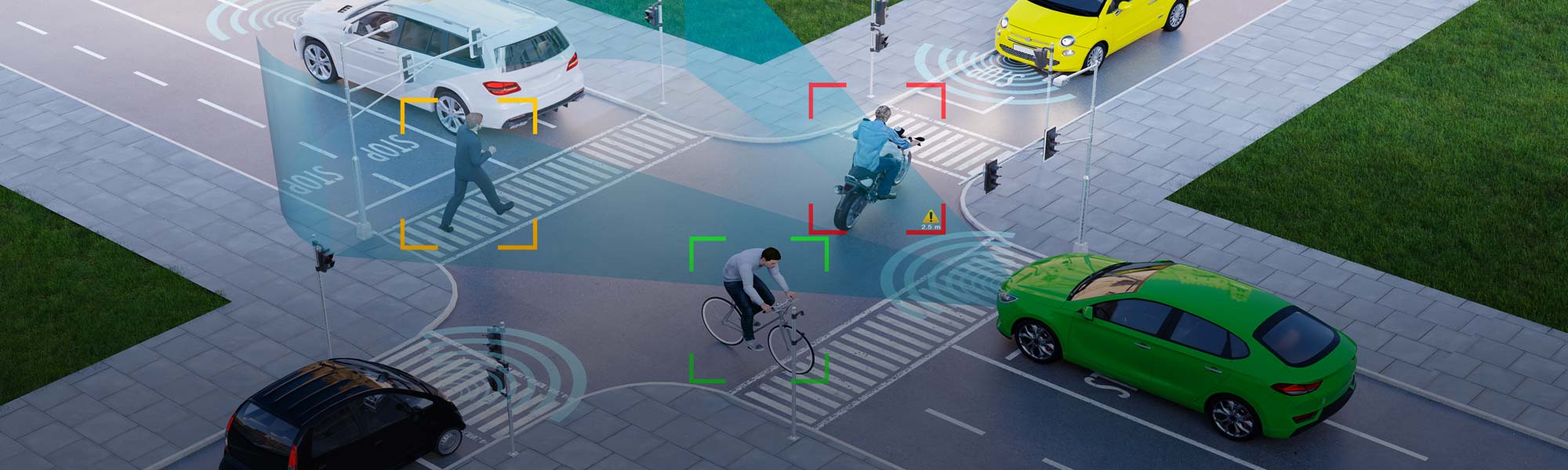
Traffic sign recognition systems based on deep learning models have been popularized in autonomous vehicles or advanced driver assistance systems (ADAS). However, the performance of these AI models is usually tested with benchmark evaluations in a laboratory. There is a lack of evaluation in real-world driving in different environments. A South Korean research institute has therefore developed an in-vehicle traffic sign recognition framework to evaluate and compare AI-based object detection and tracking models for practical validation.
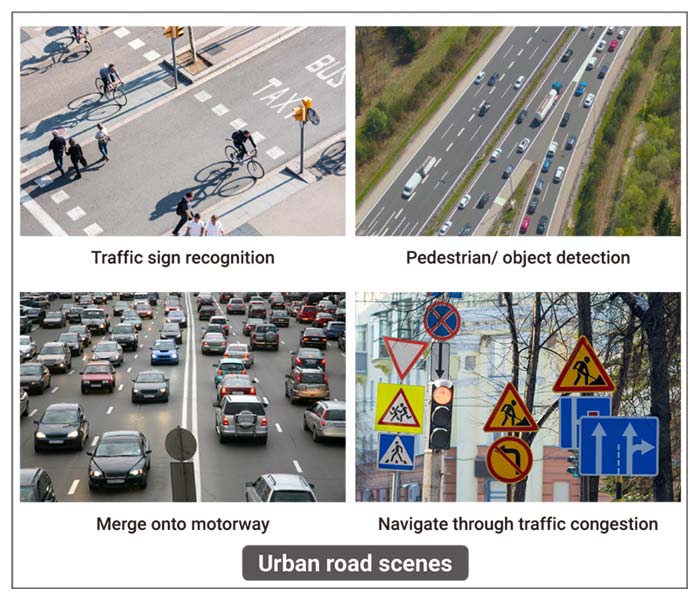
The study used a camera-equipped vehicle to collect a large set of road images for training AI models, and evaluated these models during a test drive in terms of accuracy and processing time. The experiment also proposed a categorization method for urban road scenes with scenarios for training AI models to develop a contextual awareness for Overview Deep Learning Models for Autonomous Vehicle in Real World Road Environments different road environments.
They developed an in-vehicle edge system that captures a sequence of images as the vehicle travels. These captured images are then fed into object tracking models coupled with object detection models for inference, implemented on a computing framework based on an edge computing unit and a standalone storage server from Neousys, so that they can evaluate the accuracy and latency of these deep learning models in real-world practical traffic environments.
Challenges
Image quality
A traffic sign recognition system is often plagued by poor image quality because of various environmental conditions such as weather, lighting and occlusion, which can be improved with advanced cameras and image processing algorithms, and of course, a powerful edge computing system to support the implementation.
Real-time processing
To ensure the safety of self-driving, all traffic sign recognition systems should operate at high, stringent confidence levels, with very fast processing time for recognition, supported by a high-performance edge inference system.
A super-rugged system
Such an edge AI system often uses add-on GPU cards and needs to support multiple PoE cameras for image capture, requiring a super rugged on-board computing system to ensure connectivity, computation prowess and reliability that will be challenged by thermal, in-vehicle shock and vibration conditions.
Solution
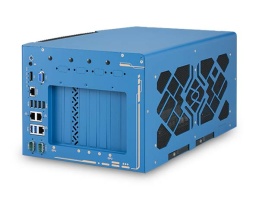
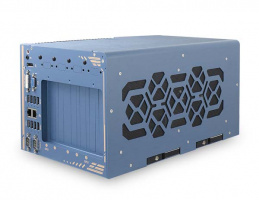
Neousys provided two edge computers to implement the edge system proposed by the S. Korean research institute: the Nuvo-8208GC, an embedded GPU computer for the on-board image storage server, and the NRU120S, an NVIDIA® Jetson AGX Xavier™-based edge AI solution for intelligent video analytics.
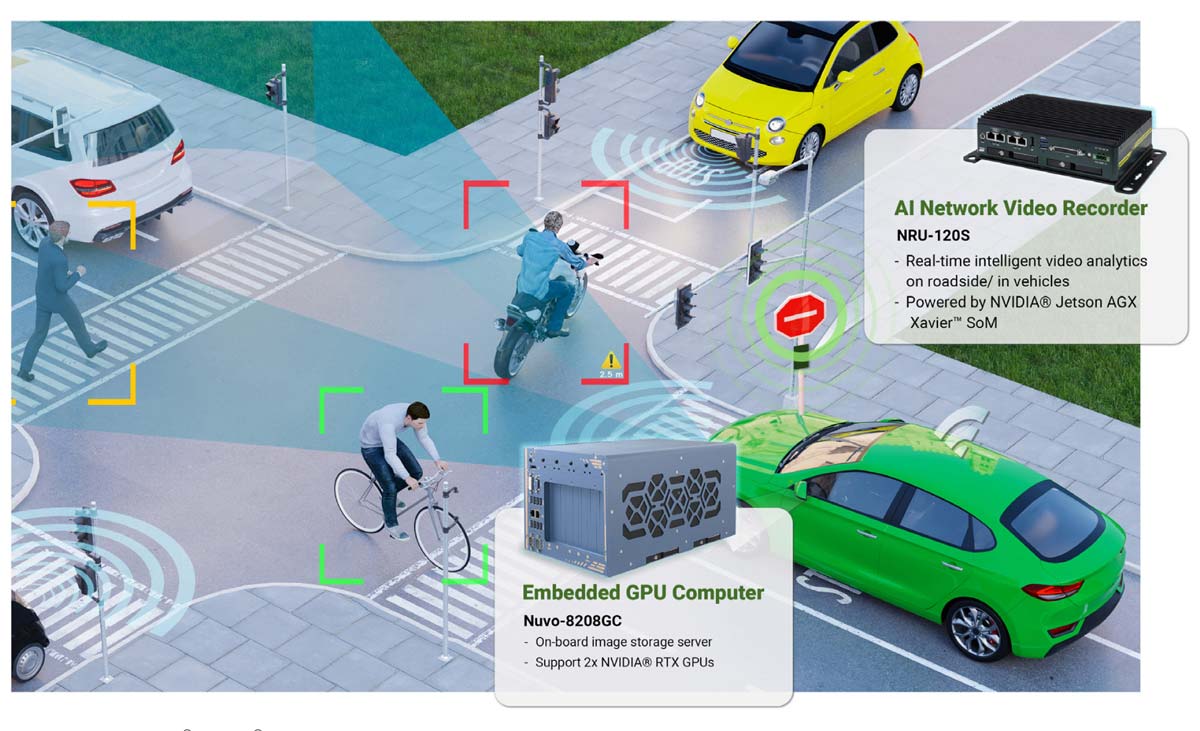
Based on an Intel® Xeon® E CPU or 9th/ 8th Gen Core™ i7/ i5 LGA1151 CPU, the Neousys Nuvo-8208GC is one of the world’s first dual GPU edge AI platforms with in-vehicle features--including 8V to 35 V wide range DC input with built-in ignition power control, -25°C to 60°C rugged operation, and patented damping brackets to withstand 3Grms vibration, in addition to a patent-pending GPU press bar--delivering unmatched performance/power ratio and rock-solid reliability at the edge.
The Nuvo-8208GC also offers ultimate disk performance with an M.2 2280 NVMe socket and two hot-swappable 2.5" trays for easy HDD/SSD replacement, perfect for storage-hungry edge applications. Another Neousys answer to the never-ending demand for TFLOPS in industrial GPU platforms is the NRU120S edge computer. Powered by the NVIDIA® Jetson AGX Xavier™ SoM, the NRU-120S delivers compelling image processing and inference performance and is ideal for real-time intelligent video analytics at the edge. It is a complete AI-based video analytics solution that provides Power over Ethernet camera connectivity, video decoding, streaming, recording and edge AI inference.