
HOME / Applications / Robots in Online Shopping
Robots in Online Shopping
Do you think about what happens behind the scenes after people place their online grocery orders?
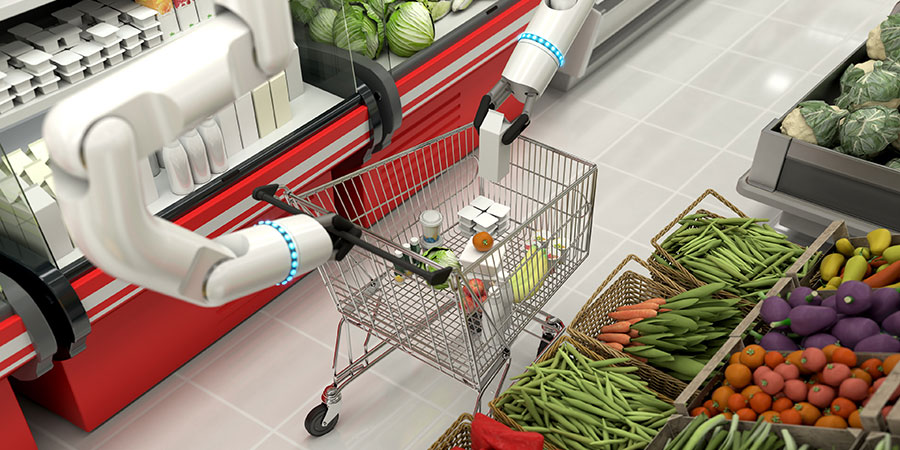
In the early days of online shopping, when you placed an order, humans would dash around a warehouse or a store collecting your items. But for years now, specialized online groceries have started using robots to collect and distribute products, bringing them to staff, who pack them into boxes for delivery to step up its game in the online grocery business.
Ocado, a UK technology-led global software and robotics platform business providing a unique end-to-end solution for online grocery around the world, allow robots retrieve items for workers to pack and delivery. Coles, Australia’s supermarket giant, is underpinned by the Ocado Smart Platform to manage online grocery demand in Melbourne and Sydney.
Asda Stores with now selling over 75,000 products, including groceries, clothing, household goods, and electronics, uses a system from Swiss automation firm Swisslog; and Norway's AutoStore in the Asda warehouse features 164 Robots and 70,000 Bins spread over an area of 1,415 sq m (15,230 sq ft).
In the US, Walmart has been automating parts of its supply chain using robotics from an softbank-backed American company called Symbotic, a leader in A.I.-powered automation platform.
Bags of rice, bottles of beer, packets of sweets can all be grabbed by robotic arms. It might seem like a trivial addition, but training a robot to recognise an item, grab it successfully and move it, is surprisingly difficult.
How does the Warehouse Automation Work?
A customer browses the online grocery store and places orders. The system receives a ticket/ bin number with a list of items to be retrieved. The system’s robotic arms are given the locations of items at the designted isle or shelf. Upon arrival, the machine vision on each robotic arm scans the package for damages, makes note of the shape and determines pickup approach angle. The item is then retrieved and placed in the corresponding bin. Several robotic arms may work in tandem, acquiring multiple items from various locations simultaneously to finish collecting all items on the list. Finally, a staff packages the items and sends it off for delivery.
Consumers are making more groceries purchases online, with the expectation of quick service, whether it be home delivery or pick-up in store. This adds pressure on warehouse management, given that the ordered groceries have to be identified, made ready and be delivered within one to two hours. Fulfilment speed has become an extremely crucial factor amid rising competition between grocers, and automated robots can help.
From the moment the robotic arm locates the item on the aisle or shelf (a pre-programmed location), the edge computer’s 3D inference machine vision capabilities can be utilized to scan the barcode for item identification, scan for package damages, recognize the item’s geometric shape for handling purposes, and control the robotic arm to complete the pickup, and dropoff for packaging and delivery.
Neousys GPU computers can be utilized at the edge to over-watch the picking, 3D scanner and robotic arm control. Coupled with 3D inference machine vision, the computer offers flexibility for inspection tasks. The accurate robotic arm movement and positioning allows for specific viewing angles. Especially when dealing with parts that have multiple geometries, reflective surfaces or when working in low light conditions, 3D inference machine vision is much more capable when handling and operating in such applications.