
HOME / Applications / Industrial Computing Solutions for Smart Pole Deployment in Smart Cities
Industrial Computing Solutions for Smart Pole Deployment in Smart Cities
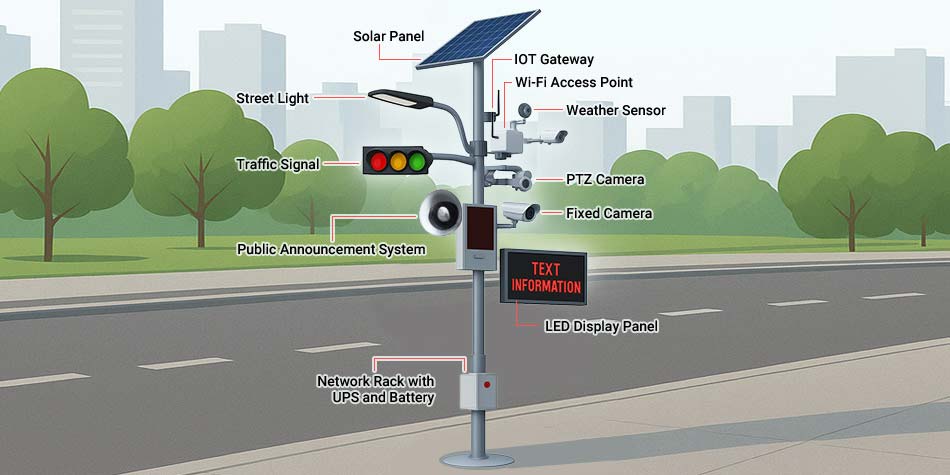
Smart poles are essential elements of smart city infrastructure, integrating technologies like Wi-Fi hotspots, surveillance cameras, traffic monitoring systems, and environmental sensors.
Wi-Fi hotspots enhance connectivity for residents and visitors, supporting digital inclusion and local economic activity. Surveillance cameras improve public safety by enabling real-time monitoring and quicker emergency response. Traffic monitoring systems collect data on vehicle flow and pedestrian movement, helping optimize traffic signals and reduce congestion. Environmental sensors monitor air quality, temperature, and noise levels, providing vital data to combat pollution and improve overall quality of life. By analyzing the collected data through centralized platforms, smart poles empower cities to make informed, timely decisions
Edge AI computers serve as crucial control units for smart poles. However, deploying a computer in a roadside cabinet for smart poles in smart cities presents several challenges. The operating environment is a primary concern, as the computer placed in these cabinets must withstand diverse weather conditions, including rain, extreme heat, and rapid temperature fluctuations. Ensuring the durability and reliability of the hardware in such variable conditions is crucial to maintaining functionality.
Fast real-time data transmission is essential for effective smart city applications, necessitating robust wireless communication systems. This can be hindered by physical obstacles and interference from urban infrastructure, potentially impacting data latency and reliability.
Connectivity for various cameras and sensors is another critical challenge. These devices require stable and rugged connections to transmit data effectively, and any disruption can compromise the system’s performance. Additionally, managing power consumption is vital, as continuous operation in a resource-constrained environment can strain local power supplies.
Addressing challenges such as harsh environmental conditions, wireless interference, connectivity stability, and power management is key to the successful deployment of edge AI IoT systems in smart city environments.
The BSMI certified Neousys Nuvo-8003 with 125W NVIDIA® GPU is ideal to power smart poles in smart cities. The BSMI certification is an electronic safety quality standard certification issued by the Ministry of Economic Affairs in Taiwan. However, the Neousys embedded system takes it one step further by incorporating a graphics card for AI inference computing, which is rare for this certification, and is harder to obtain.
The edge AI computer is built to operate reliably in harsh environments, withstanding ambient temperatures from -25°C to 60°C, and its patented thermal design ensures stable performance under full CPU load. It offers extensive connectivity, including USB 3.1 Gen1, GbE LAN, COM ports, three display outputs, and three PCIe slots—one occupied by a 125W NVIDIA® GPU—with the option to add Neousys AI frame grabber cards for enhanced edge AI video analytics without taxing the main system. This rich I/O capability allows seamless integration with traffic cameras, environmental sensors, and public displays for real-time data visualization. With proper power infrastructure, it can even support sensors for use as electronic charging stations, powering not just handheld devices but also electric scooters and vehicles.