
HOME / Applications / AI-Powered Excavator-Mounted Robotic Hands for Disaster Relief
AI-Powered Excavator-Mounted Robotic Hands for Disaster Relief
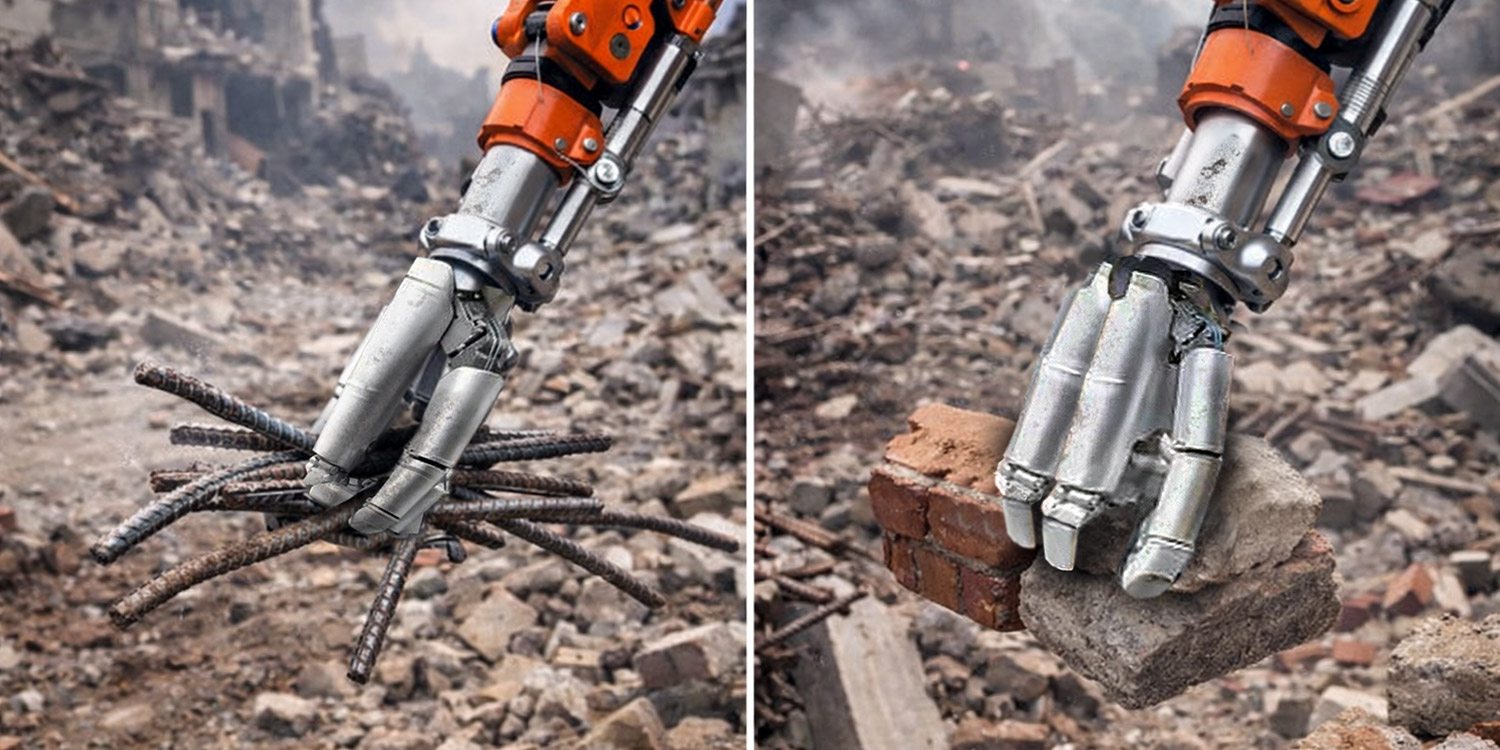
After natural disasters, rubble and contamination often make areas inaccessible to people and traditional machinery. To overcome this, a groundbreaking robotic system is transforming how heavy equipment operates in such conditions. The system features a robotic hand mounted on an excavator, merging strength with precision. Powered by pneumatic actuators that mimic muscles, the robotic hand can apply varying gripping forces, from lifting sharp debris to handling delicate objects. Tactile sensors in the palm and fingers provide real-time feedback, allowing the system to adjust its grip based on an object's shape, weight, and texture.
The AI-driven excavation system first trains in digital simulations, learning to dig, identify obstacles, and adjust actions. Instead of following fixed commands, the system learns and adapts in real time. It decides how deep to dig, how much pressure to apply, and how to remove hidden objects without destabilizing the environment. The August 2025 demonstration in Tsukuba showcased the project at Technology Readiness Level (TRL) 4, proving that the robotic hand and AI could function in a controlled environment. The next goal is TRL 5, which means showing it can operate under more realistic conditions. By November 2025, the team aims to be ready for real-world testing and eventual deployment.
The unsung hero, a rugged edge AI computer training a laboratory prototype into a machine you can trust in the rubble of a disaster site
The Edge AI computer serves as the resilient brain—compact enough to be mounted directly on the robotic arm, yet powerful enough to process massive streams of sensor data in real time. With industrial-grade ruggedness, they withstand shock, vibration, and dust while running advanced GPU-accelerated deep learning models for object recognition, path planning, and precise manipulation. Their ability to deliver instant, low-latency operator feedback ensures that excavator-mounted robotic hands can react safely and decisively, even in unstable and high-risk disaster zones.
Neousys Nuvo-9160GC, a rugged edge AI computer, delivers superior CPU and GPU performance by leveraging Intel's 14th/13th/12th Gen platform and an NVIDIA® RTX™ GPU card up to 150W. The system can accommodate selected Blackwell architecture GPU cards such as NVIDIA® RTX™ Pro 2000 while providing excellent shock and vibration resistance in volatile conditions. With a proven thermal design to guarantee reliable system operation from -25°C to 60°C. The support of GigE cameras (or IP cameras) and USB3 cameras makes Nuvo-9160GC ideal for various vision-based AI application deployments. It also provides flexible data storage options, including one M.2 2280 Gen4x4 NVMe providing up to 7000 MB/s extreme read/write speeds and two 2.5" SATA HDD/SSD to expand storage capacity. With performance enhancements and comprehensive I/Os, Nuvo-9160GC enables robotic hands to interpret complex surroundings, manipulate debris with precision, and continue operating in disaster zones too hazardous for human workers.