
HOME / Applications / AI Pollination - How Autonomous Robots are Revolutionizing Greenhouse Agriculture
AI Pollination - How Autonomous Robots are Revolutionizing Greenhouse Agriculture
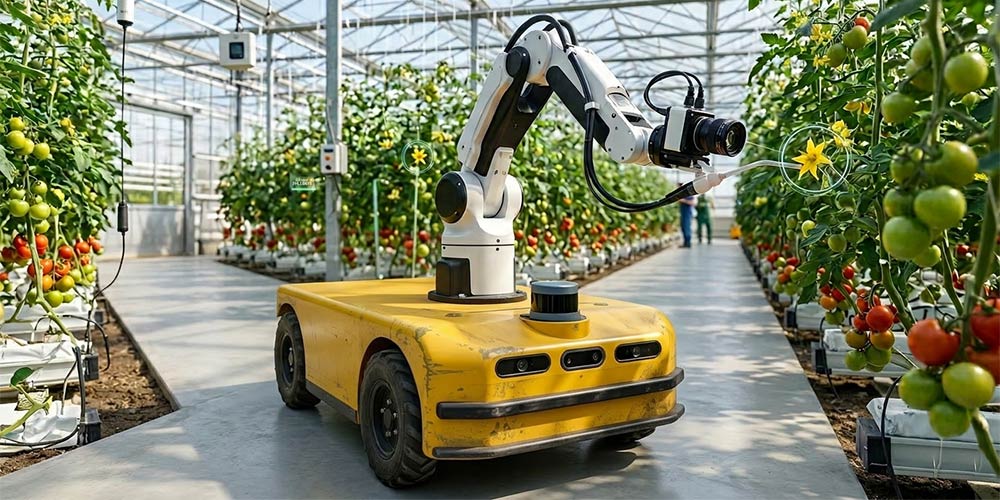
The global decline of pollinators has become a growing concern for modern agriculture, particularly in greenhouse environments cultivating higher-value crops that demand precise and reliable pollination. Traditional pollination methods rely on manual labor or natural pollinators such as bees, both of which face increasing challenges due to labor shortages, environmental changes, and lack of consistency and accuracy. To address these issues, a new generation of autonomous pollination robots powered by artificial intelligence is emerging as a promising solution. By integrating robotics, computer vision, and AI technologies, these robots can identify flowers, determine their readiness for pollination, and perform the pollination process with precision and consistency that surpass traditional approaches.
At the core of this system is an industrial edge AI computer that enables real-time decision-making directly on the robot. Instead of relying on cloud connectivity, the system processes high-resolution camera inputs and sensor data locally, allowing the robot to detect flower morphology, differentiate pollination stages, and guide robotic arm movements with millimeter-level precision. By performing AI inference at the edge, the robot can instantly analyze environmental changes and adjust its pollination actions, ensuring reliable operation even under dynamic greenhouse conditions.
However, deploying AI computing systems in greenhouse robotics presents several environmental and technical challenges. Agricultural environments often expose electronic systems to fluctuating temperatures, high humidity, dust, and agricultural chemicals such as pesticides or fertilizers, which can lead to corrosion or hardware degradation. In addition, pollination requires extremely precise robotic control, and the system must process large amounts of visual data in real time under varying lighting conditions. Any latency or processing delay could compromise pollination accuracy, making robust GPU-accelerated AI computing essential for maintaining reliable flower recognition and robotic control.
Industrial-grade edge AI platforms such as the Neousys AWP series provide the computing capability and durability required for autonomous pollination robots. Featuring a fanless design, wide temperature tolerance, and sealed enclosure with IP 66 waterproof and dustproof design, the computer is built to withstand harsh agricultural environments. Powered by NVIDIA® Jetson edge AI technology, it enables real-time image processing and precise robotic control while supporting integration with multiple sensors, cameras, and actuators. By combining rugged design with high-performance AI computing, edge AI systems make automated robot pollination a practical and scalable solution for modern greenhouse agriculture.